

How To Cross Register At Mit
Although .NET has traditionally been a Windows-simply, closed-source proprietary platform, those days are coming to an cease. The new .NET Core platform is here and it'southward open up source and cross-platform. You tin can now write your C#/.NET code once, on any platform, and run it on Windows, Linux, and macOS.
This new .NET platform is being congenital in the open on GitHub, more often than not using MIT and Apache licenses, and even accepting community contributions. This new platform has been designed from the ground upwards around the previously open-sourced Roslyn compiler (.NET Compiler Platform), and has been designed not to be tied to Windows or Visual Studio, allowing developers to work on any system in any IDE, and to run their apps on whatever server or platform.
To demonstrate this new platform, let's build a super-simple console app that we can run on Windows and Linux using the new dotnet command-line interface (CLI). To get started, you need to install .Net Core (which includes the dotnet CLI tool). Microsoft provides consummate documentation for most platforms (including a wide variety of distributions) in their online documentation.
If you don't want to install .Cyberspace Core locally, the microsoft/dotnet:latest Docker image comes pre-loaded with all the latest tools and the SDK.
i. Create our new app
.Internet Core is changing apace. These instructions are for the latest version at the time of writing.
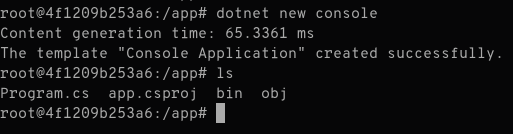
First, we can create a new console app using dotnet new console. This will automatically create a Program.cs and a .csproj named after the electric current directory (mine is app.csproj).
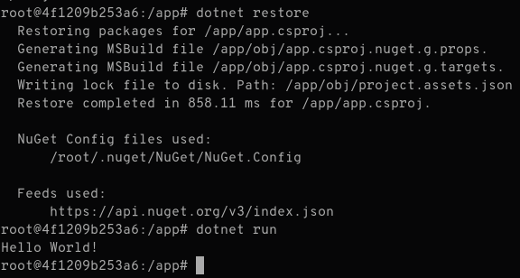
To prove this works, try running dotnet restore, which will restore any packages needed to run your app. After that finishes, run dotnet run and you should see the all-important Howdy, World! appear in your console.
2. Adding logic to our app
Open Program.cs in your favorite text editor and supercede the line that reads Console.WriteLine("Hello Earth!"); with the line below. Because .Net Cadre is non coupled to Visual Studio, y'all can employ any IDE or text editor you similar, even vi.
Console.WriteLine($"Hello {Organization.Environment.GetEnvironmentVariable("USER")}! I'g {System.Environment.MachineName} and I'm talking to you from {Organisation.IO.Directory.GetCurrentDirectory()}"); For those not familiar with C# and .Cyberspace, this code is substantially printing a more than detailed version of the classic Hello, World app, at present using information from the current environment. Notation that in that location's no platform-specific code here, either.
3. Running your new app
If you lot at present run dotnet build, you will get your .dll and other files added to your ./bin/Debug binder. You've already written a cross-platform console app. Copy those files onto another auto running .Internet Cadre—even a Linux or OS X one—and run dotnet ./path/to/your/app.dll, and you should encounter the same output as earlier; however, you're still using your local .NET runtime to do that. Fortunately, .Cyberspace Core includes the ability to build and publish native binaries in a standalone parcel so that your target system (or users) don't even need to have .Internet installed to run your app.
4. Preparing for other platforms
To prepare for a cross-platform app, we must tell the .Cyberspace Core SDK for which platforms to build. Because this process involves native libraries, nosotros must be specific about not simply which platform, but also specific flavors and versions.
Open up your .csproj file from the app directory, and add the following XML tag somewhere betwixt the
                                                    <PropertyGroup>
                              <RuntimeIdentifiers>                              win10-x64;osx.10.12-x64;debian.viii-x64                </RuntimeIdentifiers>
                              </PropertyGroup>
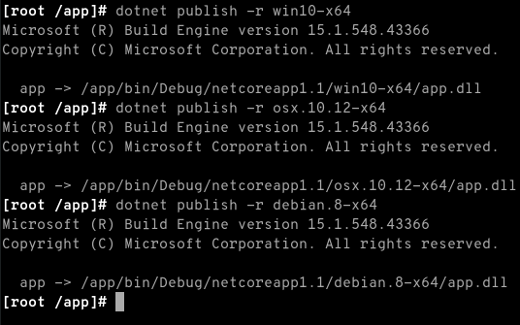
This tells .NET that nosotros want to build a self-independent version of our app for Windows x 64-bit, macOS Sierra, and Debian viii. Now all you need to do is run dotnet publish for each of the runtimes we chose earlier to compile native binaries for each platform:
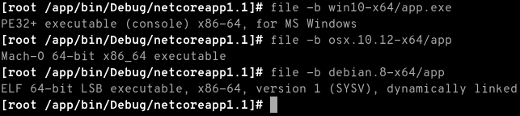
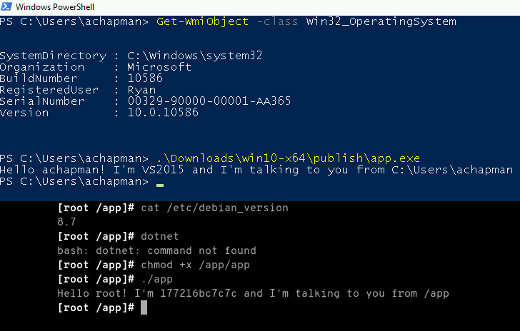
Expect in the ./app/bin/Debug/netcoreapp1.one/ folder and there will be a directory for each of our platforms, each with a publish folder. In that folder is a re-create of not merely a native version of your app, but also all the .NET libraries needed to run, then y'all don't need to install .Net on your target organization. But copy the files onto a make clean box and run the executable for the platform you're on.
Determination
Using C# and the new .NET Core platform, yous can build an app on whatsoever platform, and publish it to any platform—100% code reuse, fully native, no runtime or framework installation required. You can run across the new framework powering this applied science on GitHub (and the runtime source is too on GitHub). These are exciting times for C# and the .NET platform equally a whole.
 This work is licensed under a Creative Eatables Attribution-Share Alike iv.0 International License.

Source: https://opensource.com/article/17/5/cross-platform-console-apps
Posted by: lawsoncaph1956.blogspot.com
0 Response to "How To Cross Register At Mit"
Post a Comment